In 1715 someone cut all four sides off The Night Watch to fit it on a wall of Amsterdam's town hall. They took 64.4 centimetres from the left, 23.3 from the top, 11.3 from the bottom, 7 from the right. The strips were never found. For three centuries the most famous painting in the Netherlands was a fragment that everyone treated as a complete work.
In June 2021 the Rijksmuseum gave back what was missing. The method is in the museum's press release, written without any promotional enthusiasm: the team taught Rembrandt's technique and use of colour to artificial neural networks. The computer redid the missing parts in his style, based on a seventeenth-century copy attributed to Gerrit Lundens (Rijksmuseum, 23.06.2021).
That sentence is worth reading more carefully. A machine learned a master's way of making to the point of continuing his canvas. That describes something that stopped happening in the West around 1750.
The year craft was demoted
In 1746 the abbé Charles Batteux published Les beaux-arts réduits à un même principe, considered the first modern classification of the fine arts. On one side he placed the arts whose purpose is pleasure: music, poetry, painting, sculpture, dance. On the other, the mechanical arts, which serve needs. The division was quickly adopted across Europe and became common sense.
The hierarchy was not born there on its own, but that is where it gained its modern formulation. And the bill went to those who worked with their hands inside matter: ceramics, weaving, wood, glass. They did not become lesser arts because they did less. They became lesser arts by decree of classification. To put the title together I looked up the etymology of the word and found this (I have been looking for the author of the page for a few days to give credit, but have not found them yet). If you are reading this text in English, the detour through the Latin languages is worth it.
The broken chain
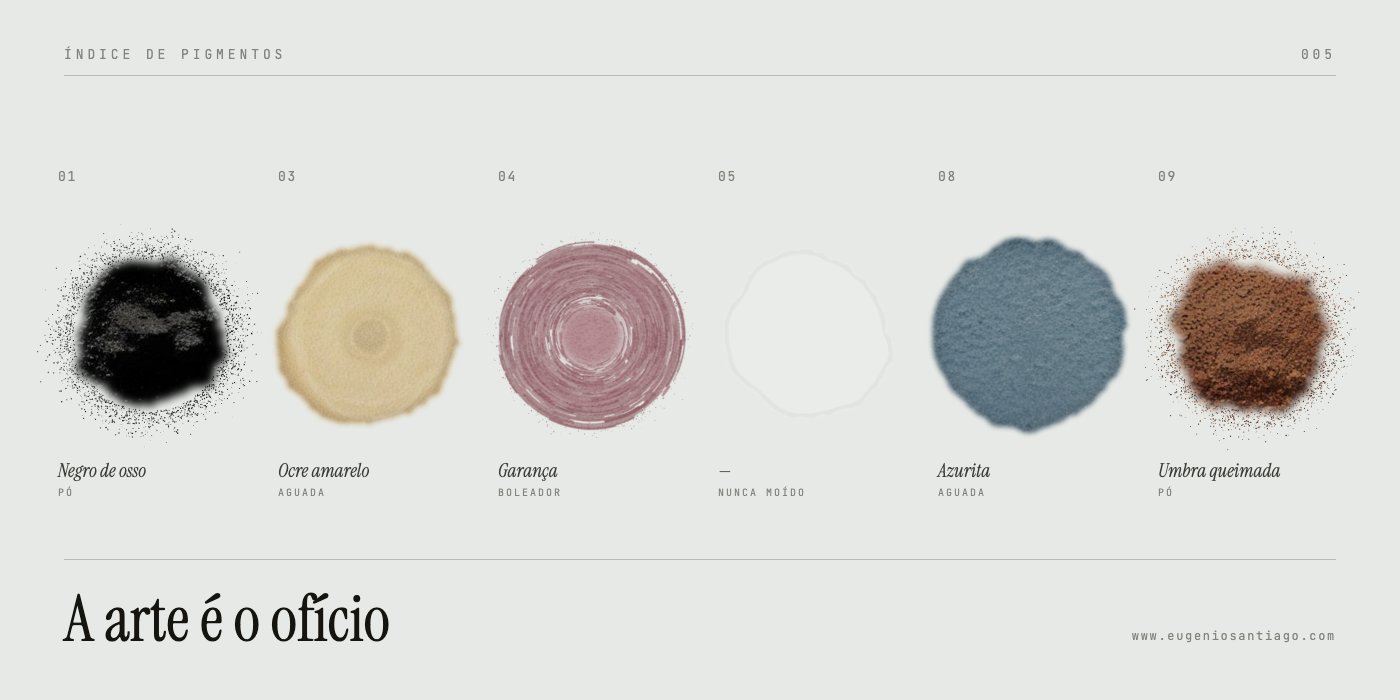
Before that, learning to paint meant entering a workshop. The apprentice spent years grinding pigment before touching a brush. Grinding pigment was not a servant's chore. It was the curriculum. It is by grinding that you discover that azurite breaks fine and ochre resists, that a coarse grind gives back brilliance and a fine one gives depth, that the same colour changes temperament depending on the oil that receives it.
None of this fitted into a manual. It passed from body to body, through a narrow, slow channel. That is exactly what the workshop system protected in order to generate knowledge.
When that channel came apart, what was lost was not the skill but the way knowledge was passed on.
The machine and the human
There is a recent measure for this. Jitao Yan, Kenneth Husted and Benjamin Fath reviewed 82 academic papers published between 2011 and 2021, selected from an initial pool of 885, to understand what artificial intelligence does with tacit knowledge (VINE Journal of Information and Knowledge Management Systems, 56(2), 522–540, DOI: 10.1108/VJIKMS-08-2024-0296).
The finding is precise. AI is good at combining explicit knowledge, the kind that has already been written down. It remains limited when facing three kinds of tacit knowledge: relational, somatic and collective. The authors conclude that personal experience and wisdom cannot be captured by data alone. They conclude that the human must stay in the loop.
Translated into the studio: the machine learns Rembrandt's recipe, but the signature cannot be transferred...
You don't make the bread rise
Anyone who ferments knows this better than anyone who designs. Nobody makes bread rise. You grind, hydrate, control the temperature, choose the moment, and hand the rest to a process that does not obey you. The yeast works on its own. The skill lies in creating the right conditions, reading the signal at the right time, recognising when it is ready. Writing this I remembered a documentary I watched long ago, whose name I can't recall nor where I saw it, in which chemists criticised the new fashion of saying healthy food is food with "less chemistry". Chemistry is in the very idea of cooking.
That is exactly the working relationship with a generative model. You don't execute. You create the conditions and judge the result. Whoever has a repertoire of material judges better, because they already know how to recognise when it is ready.
The creole keeps the grammar
Creole languages form when peoples with no common language need to understand each other. The vocabulary usually comes from the coloniser. The grammar does not. It comes from the languages that were there before. It survives underneath, structuring a language that seems entirely new.
A new tool works the same way. The vocabulary is the model's. The grammar, if there is one, is yours, made of everything you have already ground. Without a grammar of your own, you speak the tool's language, which anyone can do. And here I am one of the harshest critics of how we are handling the adoption of the new ways of working that are emerging. Everyone criticises the use of the new tools... I myself have been accused of not being the full author of my work just because I had to adapt quickly to what the new made possible. Well, my friends... I saw the telephone arrive in my home and was amazed by colour on television, I started university writing articles on a typewriter and finished on a computer, I developed photographs in a darkroom at that same university and today I record everything on a machine that fits in my trouser pocket... I saw the internet being born and the stir it caused in the way we acquire knowledge. I will write about that later, but for now let us return to the subject of this text.
And craft rose again
Meanwhile, the institution has changed sides. On now, until 31 October 2026, is the second Biennale of Contemporary Ceramics, Where the Day Starts, in the medieval city of Rhodes, a UNESCO World Heritage site: 42 artists from 18 countries, five venues, curated by Loukia Thomopoulou, Stamatia Dimitrakopoulos and Anissa Touati (neon).
Clay in an archaeological museum is not folklore there. It is Batteux's line being erased 280 years later.
Where I write this from
I have spent the last few years between academic research and visual production. The most useful thing I learned came from neither. It came from realising that the part of my work the machine does well is precisely the part I already knew how to do and was tired of doing by hand.
What it does not do is decide when it has stopped getting better. That is still repertoire. And repertoire is accumulated time with material, and it will always be a human construction, because invention comes from non-logical, unprogrammed connections and often from a mistake that was not in the plan.
What to do with this
I have written here that creativity is discipline, not a gift. That imperfection is the signature no system erases. That AI replaces execution, not direction. This text closes from the fourth side: what was missing was neither talent nor tools. It was the channel of transmission that modernity took from us.
Some questions that are simple to ask and uncomfortable to answer: Who was your master? What exactly did you grind before you started painting? Do you still remember who was in your own workshop and showed you what was special about your signature?
If the answer is "nobody" and "nothing", that is fine; it is the answer of almost everyone in our generation. But now there is an open channel again. It does not ask you to be anyone's apprentice. It asks you to have something to grind.
· · ·Eugenio Santiago is a creative director, visual artist and researcher. He writes from Berlin, where he runs Studio 60B. His doctoral research, at IALT at Leipzig University, investigates what happens to perception and authorship when the machine enters the creative process. It is the same question as this text, asked looking backwards: at the workshop, the grinding stone and the apprentice.
© Eugenio Santiago. All rights reserved. No reproduction without permission.