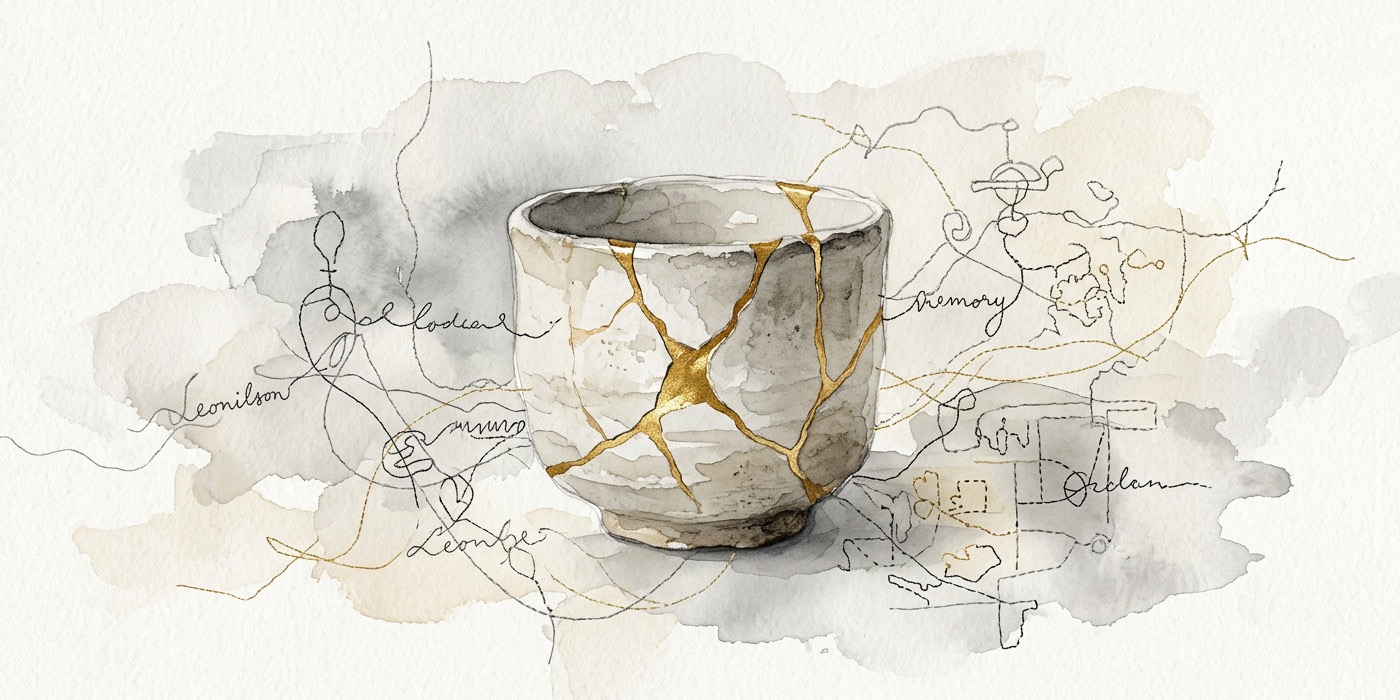
For decades, flawless execution set people apart. Whoever produced without error had an advantage, because making few mistakes took training, time, mastery. That is over. Today any system generates an image without a compositional flaw, a text without a grammatical error, in seconds. The machine does not make mistakes out of fatigue. It does not make mistakes because it had a bad day. Perfect execution is no longer an achievement. It has become the factory setting.
When the factory setting is perfection, perfection stops meaning anything.
what the machine does not get wrong
My days are very unstable... sometimes sketching a new project, other times designing agents to optimise a process, sometimes creating conceptual pieces for campaigns, but always by the rule of trial and error, getting it right, trying again, redoing and testing... Without the procedural romanticism that the first idea will be the chosen one.
It was while designing agents, on one of those days, that I made an uncomfortable observation: the more technical execution becomes flawless by default, the more obvious it is what it cannot replicate.
In 2015 Christoph Fuchs, Martin Schreier and Stijn Van Osselaer published a study in the Journal of Marketing on why we prefer handmade objects (DOI: 10.1509/jm.14.0018). Their answer was not the one I expected: it is not the effort, not the quality, not even imperfection itself. It is that a handmade object seems to "contain love" from whoever made it. They tested and ruled out the other explanations one by one.
That changes the argument. It is not the crack that matters. It is what the crack proves: that someone specific, at a specific moment, decided it.
In April 2026 Sultana, Islam, Hossain and Wasi published a study pointing the same way by another route (arXiv:2604.15324). They tested what makes audiences trust that a creative work is genuine in the age of AI, and the answer was not an imperfect end product. It was seeing the process happen, the time being spent, the decision being made in front of the observer. Almost three out of four participants would pay more for something made by a human, but what created that trust was the transparency of the process, not the visible flaw in the result.
the clay water filter again
I have already told here the story of the clay water filter I inherited. It is worth returning to it from another angle.
An industrial filter would be more efficient, more porous, without the irregularities that make every piece come out different from the last. Nobody chooses the clay filter for its efficiency. They choose it because someone decided that curve there, on that day, with that hand.
This is not exclusive to ceramics. A jazz solo recorded live carries the same logic: the note that hesitates half a tone, the timing that drags by tenths of a second because the musician felt the audience breathe differently that night. Re-recorded in the studio, corrected, it always sounds more "right" and always sounds more dead. Biology uses the same idea in a completely different register: mutation is a copying error in the genes, and it is precisely the error that gives evolution the raw material to invent something new. Without a flaw in the copy, there is no variation. Without variation, there is no selection. The perfect system does not evolve, it repeats itself.
the signature discipline does not erase
I have argued before that creativity is discipline, not a gift. I stand by that, but discipline solves a different problem from the one imperfection solves, and confusing the two is where most people go wrong.
Discipline builds the system. A disciplined system, taken to the extreme, tends towards uniformity, and that is where imperfection comes in: not as an absence of discipline, but as what remains after discipline has done its job.
Discipline is the engine. Imperfection is the signature the engine does not erase.
on Leonilson, an honest note
I like to quote Leonilson when I talk about the mark in the line, about embroidery that carries the tremor of a hand. I looked for a current exhibition of his to link here and found none on view right now. The major retrospective at KW Institute for Contemporary Art in Berlin was in 2020 and has closed. Its digital archive is still online, with the material from the show, and is worth reading further: kw-berlin.de.
what to do with this
If you work in creation, with or without AI in your workflow, the question worth carrying is no longer "how do I do this without error". It is "where in this process is there still room for a decision only I would make, in the strange way only I would make it". Protect that place. Don't smooth over the choice that makes you uncomfortable. Any system delivers flawless execution. Not the signature.
Imperfection is not the opposite of discipline.
It is what discipline, done right, allows to survive.