You have always been told that creativity is a gift. That you are either born with it or you are not. That creative people wake up inspired, that ideas arrive like lightning, that talent is a gift handed out unfairly and at random.
It is the most comfortable lie there is — because if you don't have it, it isn't your fault.
But I am here to tell you the opposite: creativity is discipline. And that, contrary to how it sounds, is much better news.
the fable of talent
There is a scene that repeats itself in every art school, every design course, every journalism programme: the student who arrives with impressive ease, who produces quickly, who seems to make no effort. Everyone looks at them and thinks: that one has the gift.
What nobody follows is what happens ten years later.
The student who "had the gift" has often stagnated — because they never had to build the muscle. Ease became a trap. The student who struggled, who rewrote three times, who stared at the same problem for hours: that one learned how to work.
Over time, consistent work always beats inconsistent talent.
I am not making this up. It is in decades of research on expertise and performance — from Ericsson to Csikszentmihalyi. But you don't need a study to see it. Just look at anyone you deeply admire in the creative field and ask: what is their routine?
The answer will always be the same: relentless.
what art taught me about existing
I studied journalism because a passion for writing takes hold of me every morning. I went on to the visual arts, furniture design and new technologies. Today I am doing a PhD on aesthetic language in Leipzig and directing projects in Berlin.
None of these worlds called me because I had a talent for them. They all called me because I needed to understand what they had to tell me. And the only way to understand is to do — repeatedly, methodically, sometimes without wanting to.
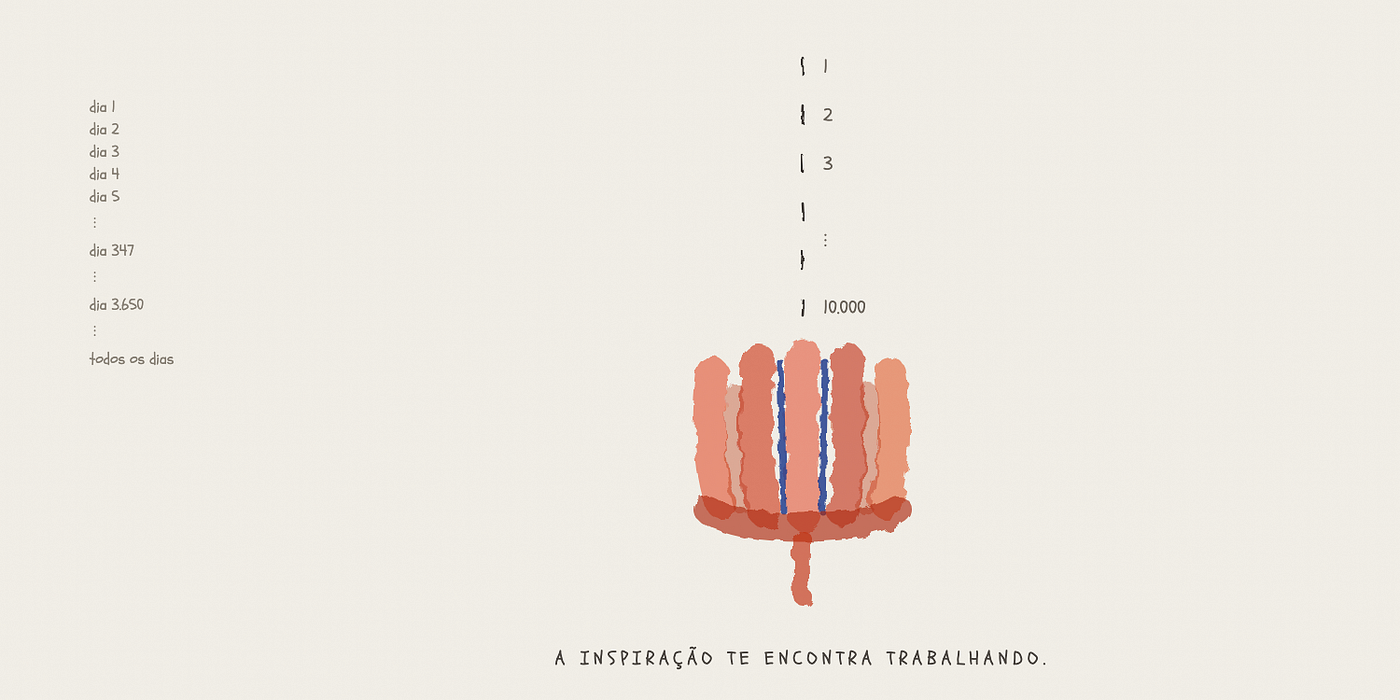
Art is not the result of inspiration. Art is what happens when you show inspiration that you will be there, whether it turns up or not.
Here is what I have learned doing this for decades:
Creativity follows presence. You don't wait for the urge — you create the conditions and the urge appears. Every day, at the same time, you sit down in front of the work. Sometimes it comes easily. Sometimes it is torture. The difference between the creative who produces and the one who only wishes to produce is that the first has learned to work in both states.
Process protects the result. When you have a method — a working ritual, a sequence of steps, a way into the problem — you don't need inspiration to start. You start. And once you start, inspiration finds you in motion.
Discipline is what gives chaos a shape. Creativity without structure is noise. Design is the shape thought takes when it refuses to remain just an idea. Discipline does not kill creativity — it makes it communicable, transmissible, useful.
the price of the myth
The myth of the creative gift charges a high price to those who believe it.
If creativity is a gift, those who "don't have it" stop trying. They give up before they start. They call creative only what they can't do — and give up the chance to develop.
If creativity is a gift, those who "have it" stop working. They rely too much on ease. They don't build the muscle because they think they don't need to.
In both cases, the myth serves only one thing: stagnation.
The alternative view — creativity as discipline — asks more of you. It asks you to take responsibility. It asks you to show up. It asks you to treat creative work with the same respect an athlete gives to training.
But it also gives more: the certainty that you can get better. Always. At any stage of life. In any field.
art disciplines you to exist
There is a dimension that goes beyond technique and process.
Art — any art, any creative form taken seriously — teaches you to look. To pay attention to what others leave aside. To see what is implicit in what is explicit. To feel the texture of time, of space, of relationships.
Whoever practises a creative form with discipline develops, without noticing, a capacity for presence that spills over into the rest of life.
It is not mysticism. It is perceptual training. Photography teaches you to frame. Writing teaches you to articulate. Design teaches you to set hierarchies. Music teaches you to hear silence.
And all of this, added together, makes a more attentive human being — more able to inhabit their own existence consciously.
Creative discipline is not about output. It is about formation. It is about who you become along the way.
what to do with this
If you are reading this as someone who "isn't creative", let me say something plainly: that identity was built, not discovered. You can take it apart.
Start small. Pick a creative field that calls you — any one. Commit to 15 minutes a day. Not to be good. To show up. Quality comes after consistency, never before.
If you are reading this as someone who "is creative" but struggles with consistency, the message is the same: build the system before you wait for the mood. The mood follows the system, not the other way round.
And if you are reading this as someone who already understands — who already treats creativity as a daily practice — then perhaps the question is: what else can you discipline? What other parts of your life are waiting for the same attention?
Creativity is not what you have.
It is what you do.
Every day.
Even when you don't want to.
Especially when you don't want to.