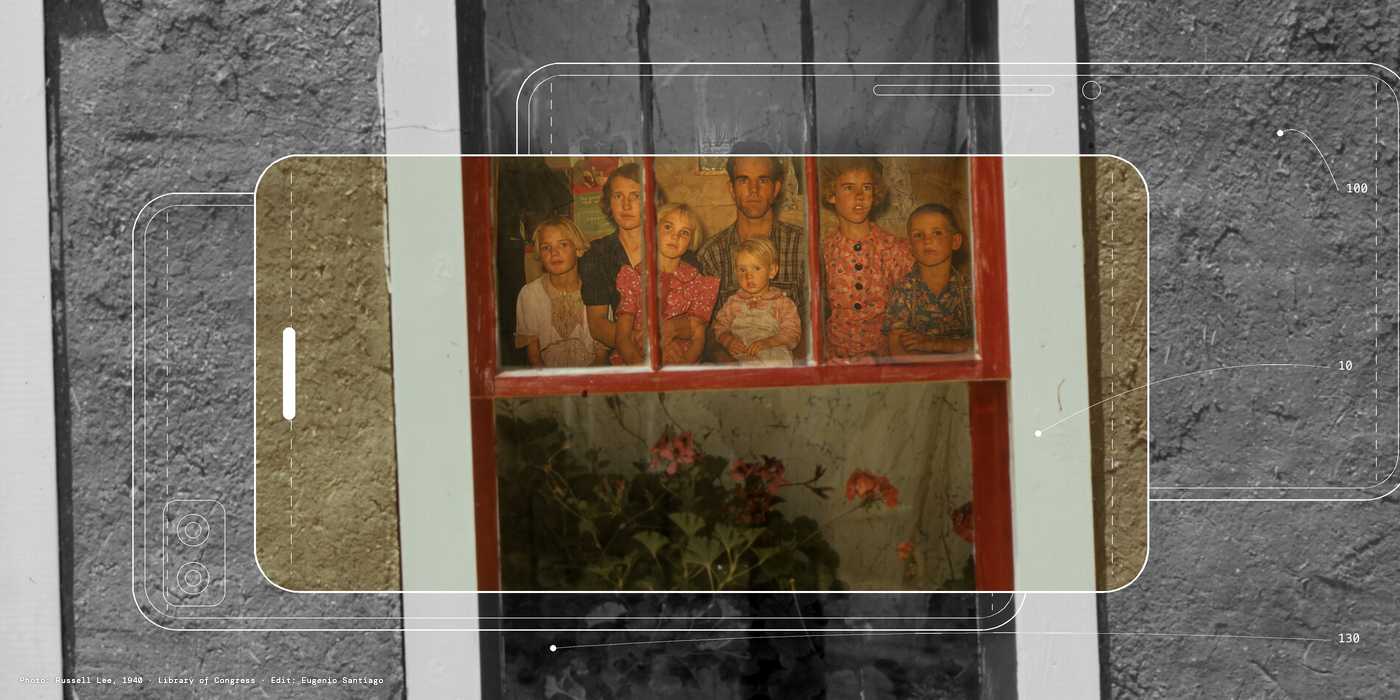
In Berlin, the exhibition Tapetenwechsel at the Ephraim-Palais starts with an everyday question: what turns a temporary place into a home? Through photographs, objects and the stories of people who have come to Germany since the 1960s, it reads furniture and matters of taste as records of a life in motion. A sofa, a curtain, a dining table: things someone chose to take along or leave behind. The exhibition runs until 3 January 2027.
The same question fits into a video call. People calling from another country tend to show a piece of where they are: the kitchen, the window, the table that hasn't been assembled yet. Sometimes the camera wanders through the room to introduce someone who has just arrived. Sometimes it stays still, pointed at a face. The room is a backdrop, and also part of the conversation. A home is shown to someone who may never walk into it.
The frame becomes a kind of floor plan. The camera decides what may enter the conversation and what stays out: the unwashed dishes, the box still taped shut, someone else's bedroom. Within seconds, the person far away learns to read the space from the fragments that appear. The sofa behind someone, the noise of the street, the light changing late in the afternoon all become part of the picture of the new address.
In 2023 the researcher Yumei Gan published a study in the Journal of Computer-Mediated Communication, “Choreographing digital love”, on video calls between Chinese parents who migrated for work and the children who stayed behind. She looks at how these encounters are organised through gestures, objects, voices and everyday tasks. The conversation includes care at a distance: showing what was sent, catching the child's attention, fitting the call into the routine of two households. Gan describes a single case, built from two years of video ethnography. Her study helps us see the call as a small domestic situation staged in two places at once.
Some people call while cooking. Others wait for Sunday, because the time difference and their shifts leave no other option. Someone asks about a relative's health; someone wants to see the grandchild; someone turns the phone to show a discovery in the kitchen fresco. What crosses the screen is more than information. It is a way of keeping up with tasks that used to happen in the same room.
Time, too, draws the digital home. A call after dinner in Berlin can land in the middle of the working day in Brazil. The conversation depends on the connection, the battery, a place to talk and whether the other side is free. Sometimes the call is short because duty calls. Other times it stays open while both households get on with different things. Presence does not fit into a simple count of minutes connected.
The phone also keeps versions of home: pictures from a party, voice notes received on the way to work, images of the bedroom after the move. Memory becomes easy to consult; its meaning still depends on whoever lived it. The photos keep who sat at the table, and the voice notes hold on to a piece of a voice. The map locates the street. The walks we took to avoid the neighbour's dog stay with whoever remembers that moment.
This archive is not neutral. The platform decides how images are sorted, which memories come up first and how long a message remains available. The digital home has its own rules of access: password, storage, data plan, an updated device. It seems like a memory always at hand, until the day an account is lost or a phone stops working. What do we keep out of convenience, and what do we preserve because we are afraid of forgetting?
There is also a work of preparation that the call tends to hide. Before answering, someone looks for flattering light, moves the phone, asks for quiet or waits for the child to come back into the room. In Gan's study the call is “choreographed” by its participants: the camera, the objects and the gestures help sustain a relationship that depends on more than one home. The choreography does not make the encounter false. It shows the work it takes. Intimacy has an infrastructure too.
Furniture tells the story of migration as well. The table that fits the rented flat, the pot bought in the first week, the chair that came in a friend's van show how someone began to settle in. In the Berlin exhibition, domestic objects are tied to housing conditions, to opportunities and to the barriers faced by those who arrive. Behind the choices of decoration, a material question returns: what was it possible to find, afford and carry?
The exhibition includes shared rooms, temporary hostels and the struggle to get a tenancy agreement. The image of a “home away from home” takes on another measure under these conditions. For many people, the first home is made of the objects that fitted into the available room and the address that could be secured.
Platforms organise presence through notifications, cameras, framing and duration. Each one offers a kind of encounter. A call can ease the longing and make plain what is still missing: the embrace, the daily care, the birthday seen on a small screen. Then comes the goodbye. The phone goes back into the pocket and the house returns to its old silence.
This contrast does not make the call less valuable. It sharpens the question: when we say technology brings us closer, do we mean seeing someone, taking part in daily tasks, being able to ask for help, or not missing an important change in the life of those who stayed? Each answer calls for a different architecture. A fast connection does not fix a conversation cut short by a work shift; a good camera does not replace the person who looks after the child every day.
One detail can change the whole experience: who holds the device. If the child has the phone, they can wander out of frame, run off to show a toy or get bored of the conversation. If an adult directs the camera, a different sequence of images unfolds. In a family call, everyone has their own idea of what deserves to be seen, and here the Brazilian classic applies: “mãe, abaixe a câmera pra eu te ver” (“Mum, lower the camera so I can see you”). The platform's design sets the features; people invent the use and negotiate attention within the limits of the screen.
What is your connection to faraway like? Why do we need presence, the physical? How did you get where you are, and what does that choice say about the place you live in now?
To read, listen and see
- See in Berlin: Tapetenwechsel — Migration und Mobiliar seit 1960, exhibition at the Ephraim-Palais, until 3 January 2027.
- Read: Yumei Gan, “Choreographing digital love”, a 2023 study of video calls between migrant parents and the children who stayed behind.
- Listen: Encontros e Despedidas by Milton Nascimento, the 1985 album that includes the title track, whose name means “Meetings and Farewells”. A soundtrack for the crossing between leaving, arriving and waiting.
Eugenio Santiago works between communication, research and visual creation. Between Minas Gerais and Berlin, he watches how the idea of home changes when the address does.
© Eugenio Santiago. All rights reserved. No reproduction without permission.