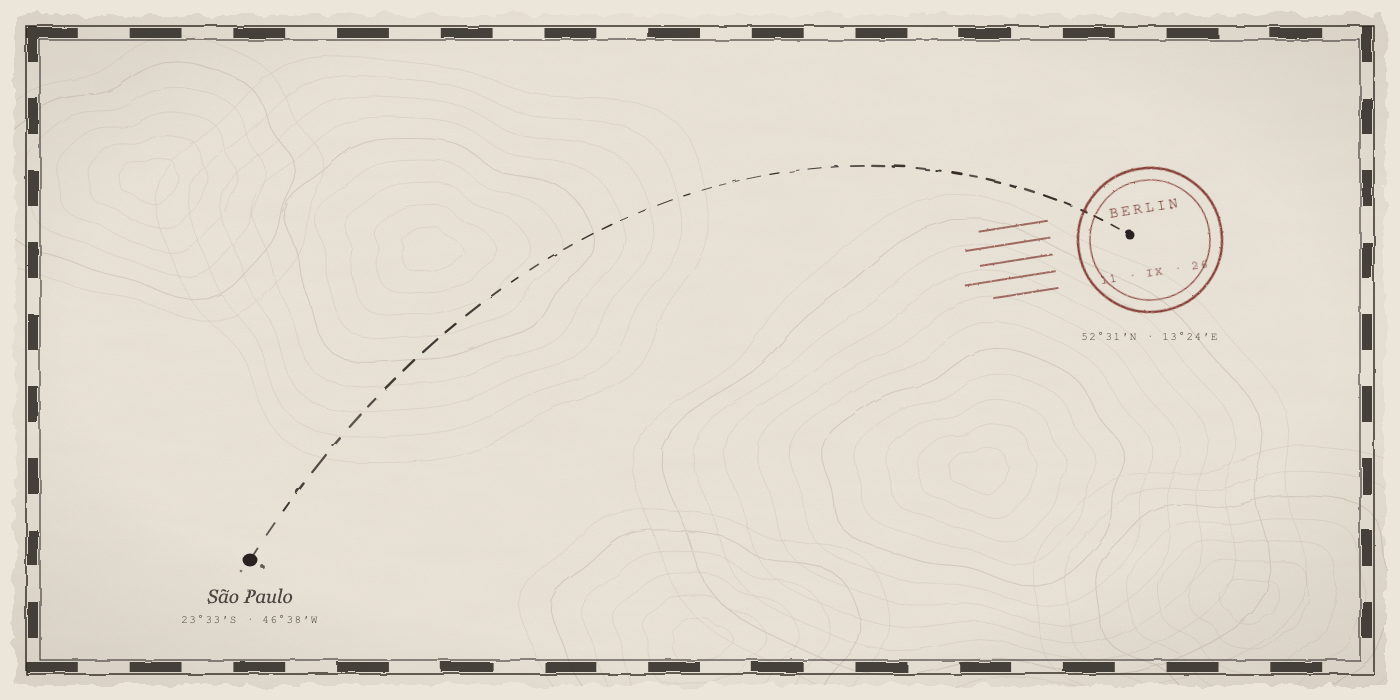
On 11 September 2026 the German edition of the 36th Bienal de São Paulo opened at Haus der Kulturen der Welt in Berlin. HKW's press release says it is the first time the exhibition has come to Germany. It brings together just over thirty artists, a leaner version of the São Paulo show, curated for Berlin by Alya Sebti. It runs until 6 December (HKW, 30.06.2026).
The title comes from lines by the Brazilian poet Conceição Evaristo: Nem todo viandante anda estradas. In Berlin it became Not All Travellers Walk Roads (36th Bienal). A poet from Minas Gerais naming an exhibition on the banks of the Spree.
None of this happened because the internet exists. Someone chose which works would travel and which would stay. Someone translated the title. Someone negotiated the building, the insurance, the freight, the dates. The biennial crossed the ocean because a group of people built the route and paid for every leg of it.
The map decides what exists
In 1946 Borges published a single paragraph about an empire whose cartographers drew a map the size of the empire itself, point for point. The generations that followed found it useless and left it in the desert, where it was probably lost.
Platforms promise that map. Everything available, everywhere, at the same scale. The result looks a lot like the story: an endless catalogue where nothing can be found unless someone has already decided what to show. A useful map is made of what it leaves out. Whoever draws it chooses which river appears and which village disappears.
The Brazilian culture that reaches Europe has gone through those choices. It arrives because a curator, an editor, a translator or a friend thought it was worth the trip. Without that hand, the periphery stays in the archive, available in theory and invisible in practice.
A letter only arrives because the route is kept
In 1874 delegates from 22 nations met in Bern. On 9 October they signed the treaty that created the General Postal Union, today the Universal Postal Union (UPU). Before it, a letter crossing borders depended on separate agreements between each pair of countries.
The treaty did not invent paper, ink or the journey. It invented the common rule, the guarantee that the letter would be delivered on the other side. A postal network works because someone keeps the route, the stamp, the post office and the postman who knows the street.
The internet solved transport, there is no denying it. Part of the postman's job is still open, though: the person who knows the address, who knows both neighbourhoods and who hands the message to whoever needs to receive it.
To translate is to choose what survives
Walter Benjamin wrote Die Aufgabe des Übersetzers, "The Task of the Translator", as the preface to his own translation of Baudelaire's Tableaux parisiens, published in Heidelberg in 1923 (University of Mainz, Germersheim). The idea that has travelled a century is simple to state: translation is part of the life a work keeps living after it is born. The work survives in another language because someone carried it there.
That moves the translator to a different place: the translator decides what stays alive on the other side. Every cultural bridge has that decision in the middle. Someone chooses the word, the tone, what is lost and what is saved.
My doctoral research sits in this field, at an institute of applied linguistics and translation. The question that occupies me is a close one: what happens to perception and authorship when a machine steps into the middle of the road. The machine translates fast. It still does not know who it is translating for, or in what context the result will be used, and so the bridge never quite gets built.
Where I write this from
I have lived in Berlin since 2019. Almost everything I brought from Brazil passed through someone's hands before it reached anyone. A reference that needed context, a joke that only worked once it was explained, a piece of work that was only seen because someone opened the door.
This work of passage has a name in many professions and almost never shows in the final result. The biennial at HKW shows the works. The route, or the presence, that brought them stays behind the wall.
For those who want to cross
A few questions for anyone working between two cultures: Who drew the map you used to reach the other side? Who was your postman? For whom have you been playing that role?
If the answer is still "no one", that's fine. A bridge begins to exist when someone accepts the cost of translating. That someone can be you.
· · ·Eugenio Santiago is a creative director, visual artist and researcher. He has lived in Berlin since 2019, where he runs Studio 60B. His doctoral research at IALT, Leipzig University, looks at what happens to perception and authorship when the machine enters the creative process. Carrying work and ideas from Brazil to Germany is his daily craft, and it is the bridge this text is about.
© Eugenio Santiago. All rights reserved. No reproduction without permission.